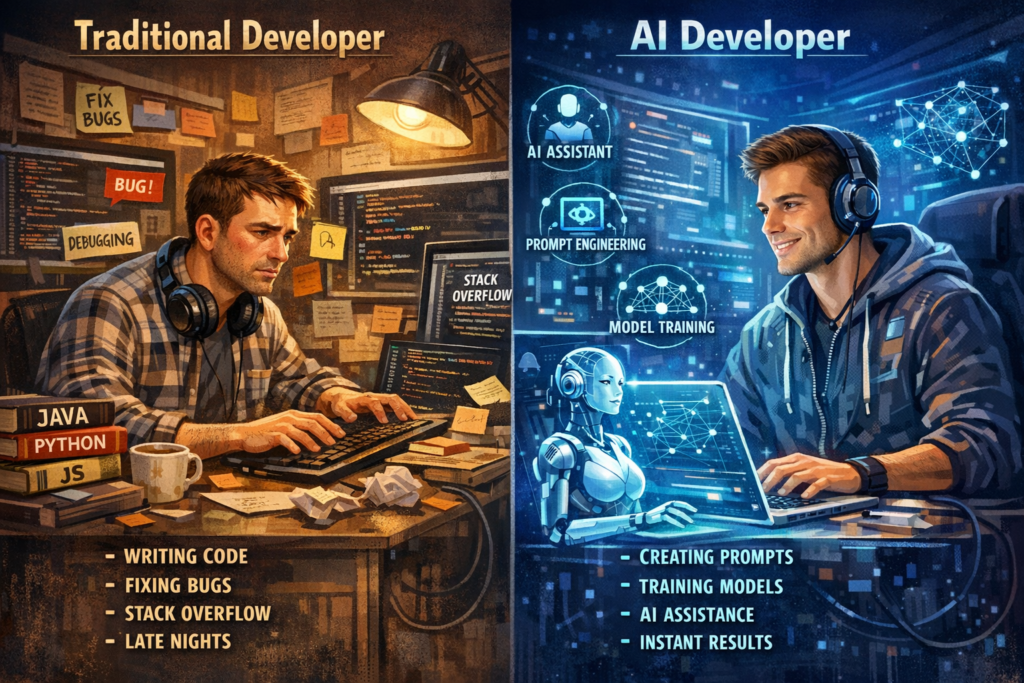
Software development has many roles, but the daily routine can vary greatly. When you compare traditional programmers and ai developers, the differences become clear. Both work with code and solve problems. However, the way they approach tasks can look very different.
If you are exploring a career in technology, understanding these differences helps you see where your interests fit best. Some developers enjoy building application features. Others enjoy training intelligent systems with data.
Let’s take a closer look at how the daily work of ai developers compares with traditional software developers.

Working With Data vs Building Features
One major difference involves the type of work you handle every day. Traditional developers often focus on building application features. They write code that manages user interfaces, server logic, or databases.
For example, you might create login systems or payment features. Much of your work revolves around making software run smoothly for users.
The daily work of ai developers usually begins with data instead of features. AI systems learn from data, so preparing data becomes an important task.
You may spend time collecting datasets or cleaning messy information. Sometimes you transform raw data into a format suitable for machine learning models.
This preparation step is essential because AI systems depend heavily on data quality.
Once the data is ready, ai developers begin training models that can recognize patterns or make predictions.
While traditional developers focus on application behavior, AI specialists focus on teaching machines how to learn.
Training Models vs Writing Business Logic As Ai Developer
Another difference appears in the type of code written each day. Traditional developers often write business logic that defines how applications behave.
For example, you may create rules that determine how orders are processed. You may also write code that handles user actions.
In contrast, ai developers write code that trains machine learning models. These models analyze data and discover patterns automatically.
Instead of defining every rule manually, the developer trains a system to learn from examples.
This means you often work with machine learning frameworks and data pipelines. Training models may involve adjusting parameters and running experiments.
Because of this experimental nature, the workflow of ai developers often includes testing multiple model variations.
Some models perform better than others, so evaluation becomes part of daily work.
Debugging Code vs Debugging Models
Every developer spends time debugging. However, the debugging process looks slightly different in AI projects.
Traditional debugging involves finding errors in code logic. For example, a variable might contain the wrong value.
You read the code carefully and correct the mistake.
For ai developers, debugging often involves analyzing model performance. Sometimes the code works perfectly, but the model produces incorrect predictions.
When this happens, you investigate the dataset or training process. The issue may come from poor data quality or incorrect parameters.
This type of debugging feels more like detective work.
You examine patterns and results rather than only reading code lines.
Because of this difference, the daily workflow of ai developers includes frequent evaluation of training results.
Here you can learn more about the Debugging
Experimentation Is a Bigger Part of the Job
Traditional development often follows a predictable structure. Developers plan features, write code, and test functionality.
AI development includes much more experimentation.
Many ai developers run multiple experiments to find the best model performance. They may adjust learning rates or change algorithms.
Each experiment produces new results to analyze.
Sometimes small changes can significantly improve accuracy.
This trial-and-error process is common in artificial intelligence projects.
While traditional developers also test code, AI work involves more scientific experimentation.
If you enjoy exploring ideas and analyzing results, this workflow can be very exciting.
Collaboration With Different Teams
Another interesting difference involves collaboration. Traditional developers often work closely with designers, product managers, and backend engineers.
These teams focus on building application features and improving user experience.
The work of ai developers often includes collaboration with data scientists and analysts.
These specialists help collect and interpret large datasets.
Sometimes developers also work with researchers when building advanced AI systems.
Because artificial intelligence projects rely heavily on data, teamwork with data experts becomes essential.
This creates a slightly different work environment compared to traditional development teams.
Tools and Technologies Used Daily
The tools used during daily work also differ between roles.
Traditional developers often use frameworks designed for building applications. These tools help create websites, mobile apps, and software services.
Common tasks include writing API endpoints or designing database queries.
The toolkit of ai developers usually includes machine learning frameworks and data processing libraries.
These tools help train models and analyze datasets efficiently.
While both roles involve programming languages, the surrounding tools may vary.
This difference shapes the daily workflow of each developer type.
Learning Never Stops

Both types of developers must keep learning new skills. Technology evolves quickly, and new tools appear frequently.
However, ai developers often spend more time reading research papers or studying machine learning techniques.
Artificial intelligence moves rapidly because new algorithms appear regularly.
Traditional developers also learn new frameworks and languages.
Yet AI development requires constant curiosity about how machines learn and improve.
If you enjoy exploring emerging technologies, this field offers many opportunities.
Explore the best ai tools for coding
Skills Shared by Both Roles
When people compare traditional developers and ai developers, they often focus on the differences. AI specialists work with machine learning models, while traditional developers build applications and software systems. However, many important skills are shared between both roles.
No matter which path you choose, strong technical foundations remain essential. Developers in both fields solve problems, write code, and improve digital systems.
If you want to succeed as a programmer, these shared skills will help you grow. Let’s explore the abilities that both traditional developers and ai developers rely on every day.
Strong Programming Fundamentals
Programming knowledge forms the backbone of both roles. Without solid coding skills, it becomes difficult to build software or train intelligent systems.
Both traditional developers and ai developers must understand programming languages clearly. Languages like Python, JavaScript, and Java appear frequently in modern development.
You need to know how to write functions, loops, and conditions. These basic concepts power almost every application and algorithm.
Understanding data structures is also important. Lists, arrays, dictionaries, and trees help organize information efficiently.
When developers know these foundations well, they can solve problems faster. Whether building an application or training a model, programming fundamentals remain critical.
This shared skill helps developers adapt to new technologies as they emerge.
Problem-Solving and Logical Thinking
Programming is essentially problem solving. Every project presents challenges that require careful thinking.
Both traditional programmers and ai developers must analyze problems logically before writing solutions.
You might need to improve performance in an application. You may also need to adjust an algorithm to produce better predictions.
In both cases, the process begins with understanding the problem clearly.
Developers often break large problems into smaller pieces. This makes solutions easier to design and implement.
Logical thinking also helps you identify patterns and connections.
When building software or training AI models, these reasoning skills guide your decisions.
Strong problem-solving ability often separates great developers from average ones.
Understanding Software Development Practices
Good development practices are important for every programmer. Writing working code is not enough.
Developers must also ensure their code remains readable, maintainable, and reliable.
Both traditional programmers and ai developers follow similar development practices.
Version control systems like Git help track code changes. These tools allow teams to collaborate efficiently.
Developers also use testing to verify that software behaves correctly.
Even ai developers rely on testing when building machine learning pipelines.
By following these practices, developers reduce bugs and maintain stable projects.
These habits improve teamwork and help projects grow successfully over time.
Communication and Collaboration
Many people imagine developers working alone in front of a computer. In reality, programming often involves teamwork.
Developers communicate with designers, product managers, and other engineers.
Clear communication helps everyone understand project goals and technical challenges.
Both traditional developers and ai developers must explain their work to teammates.
For example, an AI specialist may describe how a machine learning model makes predictions.
A software developer may explain how a feature works within an application.
When developers communicate clearly, collaboration becomes smoother.
This teamwork helps teams deliver better products and solve problems more efficiently.
Curiosity and Continuous Learning
Technology evolves rapidly, and developers must keep learning. New frameworks, languages, and tools appear every year.
Both traditional programmers and ai developers rely on curiosity to stay updated.
Developers often read documentation, explore tutorials, or test new tools.
This habit helps them adapt to industry changes.
Artificial intelligence moves particularly fast. However, software development also evolves constantly.
Because of this, lifelong learning becomes a shared skill.
Curious developers enjoy exploring new ideas and experimenting with different approaches.
This mindset helps them remain valuable in a fast-changing industry.
Attention to Detail
Small details matter in programming. A missing symbol or incorrect variable can break an entire system.
Developers must pay close attention to the code they write.
Both traditional programmers and ai developers develop strong attention to detail over time.
For example, developers check their logic carefully before running programs.
They review code to ensure everything works correctly.
Even small improvements can make software easier to maintain.
Attention to detail also helps developers detect bugs quickly.
This skill becomes especially important when working on large and complex projects.
Understanding System Design
Another shared skill involves system design. Developers must think about how different parts of software interact.
Traditional developers design application structures that handle user requests efficiently.
Meanwhile, ai developers design pipelines that process data and train models.
Although the systems differ, the design thinking remains similar.
Developers must consider performance, scalability, and reliability.
When systems grow larger, thoughtful design becomes essential.
This ability allows developers to build solutions that continue working as demand increases.
Where AI Developers Have an Edge
Technology evolves quickly, and new roles appear as industries change. One role that continues to grow rapidly is the field of ai developers. These professionals combine programming skills with knowledge of artificial intelligence.
Traditional developers build powerful applications, websites, and software systems. However, AI specialists often work on problems that require machines to learn from data.
Because of this unique ability, ai developers bring special advantages to modern technology teams. Their skills allow companies to build smarter systems that improve over time.
Let’s explore several areas where AI specialists often have an edge.
Turning Data Into Smart Decisions
One major advantage of ai developers is their ability to transform data into useful insights. Today, companies collect enormous amounts of information every day.
Customer activity, website traffic, and product behavior all produce valuable data.
Traditional developers may store or process this information. However, AI specialists focus on teaching systems how to learn from it.
For example, an AI system might analyze shopping behavior to recommend products. Another system might predict equipment failures before they happen.
These capabilities give ai developers a strong advantage in data-driven industries.
When businesses use data intelligently, they make better decisions and improve customer experiences.
Because data continues to grow worldwide, the ability to analyze it becomes extremely valuable.
Building Systems That Learn Over Time
Traditional software follows fixed rules written by developers. Once the rules are defined, the program behaves exactly as designed.
Artificial intelligence works differently. Systems trained by ai developers can improve through learning.
Instead of following strict instructions, AI models analyze patterns in large datasets.
Over time, the system becomes better at recognizing patterns and making predictions.
For example, a recommendation system might improve after analyzing user behavior for months.
This ability to evolve gives ai developers an important edge in modern technology.
Companies value systems that adapt automatically without constant manual updates.
These adaptive systems help businesses remain competitive in fast-changing markets.
Solving Complex Problems With Automation
Many real-world problems are too complex for traditional rule-based software. Tasks such as speech recognition or image classification require advanced learning techniques.
This is where ai developers shine.
Artificial intelligence models can identify patterns that humans might overlook.
For example, AI systems can detect diseases in medical images or recognize objects in photographs.
These capabilities allow developers to automate tasks that once required human analysis.
When ai developers build these systems, organizations save time and resources.
Automation powered by AI also allows teams to focus on more creative tasks.
This makes artificial intelligence an important tool across industries.
Improving User Experiences With Personalization
Modern users expect digital products to feel personalized. They want recommendations that match their interests and needs.
AI specialists play a key role in creating these personalized experiences.
By analyzing user behavior, ai developers design systems that adapt to individual preferences.
Streaming platforms, online stores, and social media platforms use these techniques frequently.
For example, a video platform may suggest content based on your viewing history.
This type of personalization improves user satisfaction and engagement.
Because ai developers understand machine learning algorithms, they can design systems that deliver these experiences effectively.
Personalized technology helps companies build stronger relationships with users.
Creating Innovative Products
Another advantage of ai developers is their ability to create entirely new types of products.
Artificial intelligence opens doors to technologies that were impossible in the past.
Voice assistants, recommendation engines, and self-driving systems all rely on AI.
Developers working in this field often push the boundaries of innovation.
Their work can transform industries such as healthcare, transportation, and finance.
Because AI technology continues evolving rapidly, ai developers often lead the creation of groundbreaking solutions.
This innovation potential attracts companies searching for new opportunities.
Businesses understand that AI can unlock powerful new capabilities.
High Demand Across Many Industries
The demand for AI expertise continues growing worldwide. Companies in many industries are searching for professionals who understand machine learning and data science.
As a result, ai developers often enjoy strong career opportunities.
Organizations need experts who can build intelligent systems and analyze complex data.
Industries such as healthcare, finance, retail, and technology all rely on AI innovation.
Because of this demand, AI specialists often work on exciting projects that shape the future of technology.
Many startups and research teams also depend on AI expertise.
This demand gives ai developers a strong advantage in today’s job market.
Combining Creativity and Technical Skills
Working in artificial intelligence requires both creativity and technical knowledge. Developers must design models, analyze results, and improve algorithms.
This blend of creativity and analysis makes the role exciting.
Many ai developers enjoy experimenting with new approaches to solve difficult problems.
Sometimes a small adjustment to a model can dramatically improve performance.
Exploring these possibilities makes AI development feel like scientific discovery.
For developers who enjoy innovation and experimentation, this field offers many opportunities.
How Teams Benefit From Ai Developers And Traditional Developers.
Technology teams work best when different skills come together. Some developers focus on building applications and system features. Others focus on training intelligent systems with data. When both roles collaborate, powerful solutions appear.
Traditional developers and ai developers each bring unique strengths to a project. One group focuses on building reliable software. The other group builds systems that learn and improve over time.
When these skills combine, development teams can create smarter and more useful products. This collaboration is becoming increasingly common in modern technology companies.
Let’s explore how teams benefit when both roles work together.
Combining Software Stability With Intelligence
Traditional developers specialize in building stable software systems. They create the foundation that applications rely on every day.
This foundation includes databases, user interfaces, and application servers. These systems must run smoothly and handle large numbers of users.
Meanwhile, ai developers focus on adding intelligence to those systems. They design models that analyze data and produce predictions.
For example, an online store may need a recommendation engine. Traditional developers build the shopping platform itself.
Then ai developers create models that suggest products to customers.
Together, these teams deliver an experience that feels both reliable and intelligent.
Without this collaboration, the product might lack either stability or advanced features.
Faster Innovation Across the Team
When different specialists work together, innovation often accelerates. Each team member contributes expertise from a different perspective.
Traditional developers understand system architecture and performance optimization. They know how to build scalable platforms.
At the same time, ai developers bring knowledge about machine learning and data analysis.
When these skills merge, teams can experiment with new ideas quickly.
For example, a company might want to analyze customer behavior patterns.
Traditional developers prepare the data pipelines and system infrastructure.
Then ai developers train models to interpret the data and identify trends.
This teamwork allows organizations to innovate faster than isolated teams.
Innovation grows when diverse technical skills interact.
Better Problem Solving With Ai Developers
Many technology problems require multiple types of expertise. A single developer rarely solves every challenge alone.
Traditional developers often focus on solving system-level issues. They optimize performance and ensure applications remain stable.
Meanwhile, ai developers analyze patterns hidden inside large datasets.
When teams combine these perspectives, problem solving becomes stronger.
For example, imagine an application that struggles with user engagement.
Traditional developers may improve interface performance and loading speed.
At the same time, ai developers analyze user behavior to understand why engagement drops.
Together, the team identifies both technical and behavioral factors.
This broader approach leads to better solutions.
Here the 10 best ai tools for coding you need
Ai Developers Building Smarter Products
Modern software increasingly relies on intelligent features. Users expect systems that adapt and respond to their needs.
This is where collaboration between teams becomes valuable.
Traditional developers build the core application features that users interact with.
Meanwhile, ai developers create models that personalize the experience.
For example, music streaming platforms recommend songs based on listening habits.
Traditional developers design the platform that plays music and manages accounts.
Then ai developers train recommendation models using listening data.
The result is a product that feels both functional and intelligent.
Users benefit from software that understands their preferences.
Improving Efficiency Across Projects
Team collaboration also improves development efficiency. When responsibilities are clearly defined, developers work more effectively.
Traditional developers focus on system performance and infrastructure.
Meanwhile, ai developers focus on machine learning models and data processing.
This division of work allows each specialist to concentrate on their strengths.
Instead of learning everything alone, developers contribute expertise where they excel.
Projects move forward faster because tasks are handled by the right experts.
Efficient teamwork also reduces errors and improves project quality.
Learning From Each Other
One of the biggest benefits of mixed teams is shared learning. Developers often expand their knowledge by observing colleagues.
Traditional developers may learn basic machine learning concepts from ai developers.
Similarly, AI specialists may learn more about software architecture and performance optimization.
This knowledge exchange strengthens the entire team.
Developers become more versatile and capable of solving complex problems.
Collaboration also encourages curiosity and experimentation.
Over time, teams develop stronger technical skills collectively.
Creating Future-Ready Development Teams
Technology continues evolving rapidly. Companies need teams that can adapt to new challenges.
Combining traditional developers with ai developers helps organizations prepare for the future.
AI technology is becoming part of many digital products. Teams that understand both software engineering and artificial intelligence gain a competitive advantage.
These teams can build systems that are not only functional but also intelligent.
Future-ready development teams focus on both reliability and innovation.
This balance helps companies stay ahead in a competitive market.